How Promotion Decisions Get Made: Who Decides and What They Weigh
Nov 10, 2026
- At most mid-size and large companies, a promotion is decided in stages: someone nominates you, your manager builds a case, a group of leaders compares candidates in a calibration or talent review meeting, and a senior leader or HR signs off.
- Your manager rarely decides alone. The final call usually happens in a meeting you are not in.
- The people in that room weigh six things: Results & Impact, Visibility, Influence & Relationships, Sponsorship, Executive Presence and Role Readiness.
- Performance gets you into the conversation. How the room sees your readiness for the next level decides the outcome.
How are promotions decided at work?
Promotions are decided through a review process that involves more people than your boss. The details vary by company, but the pattern is consistent. A manager puts a name forward, the case gets compared against other candidates by a group of leaders, and someone with budget authority approves it.
What are the stages of a promotion decision?
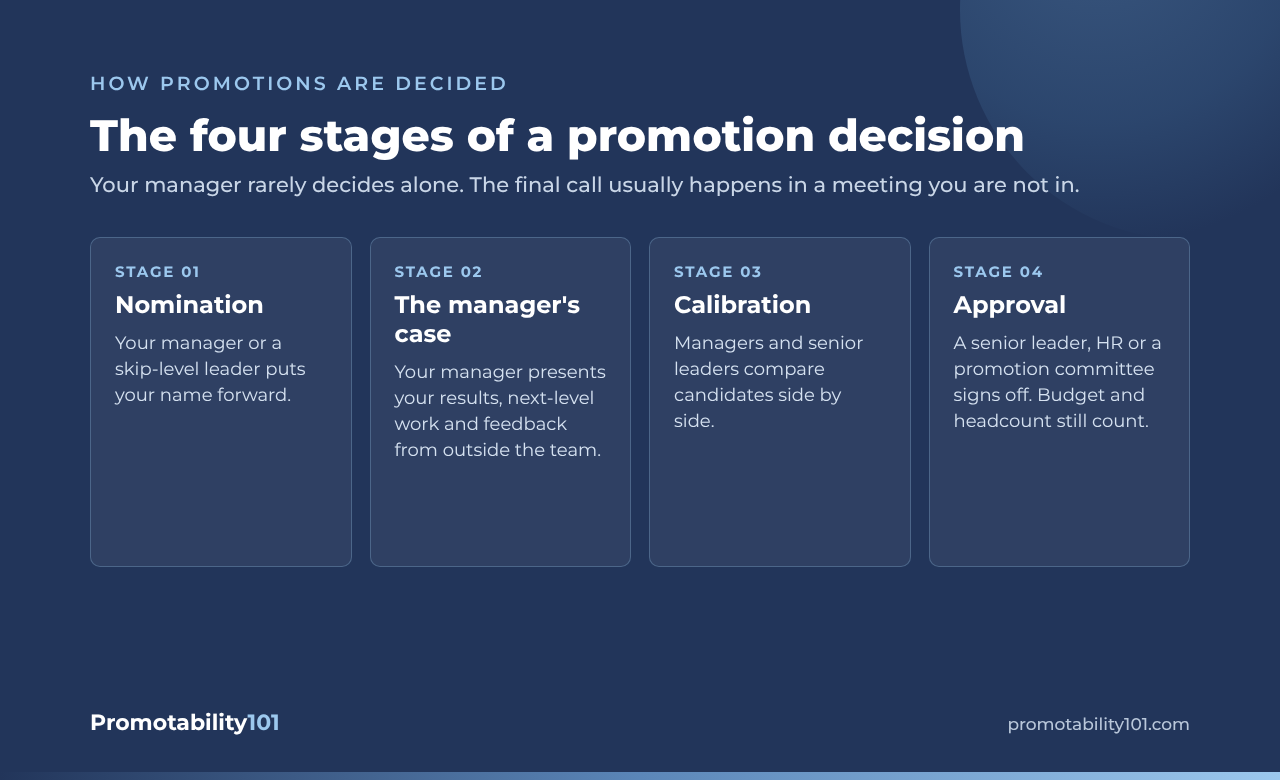
Most promotion decisions move through four stages:
- Nomination. Your manager, or sometimes a skip-level leader, decides you are worth putting forward. At some companies you can nominate yourself. At most, a name only enters the process when someone with standing says it out loud.
- The manager's case. Your manager writes or presents the argument for you. That usually includes your results, examples of work at the next level, and feedback from people outside your team.
- Calibration or talent review. A group of managers and senior leaders reviews candidates side by side. They compare ratings, challenge each other's cases, and sort people by performance and potential. Many companies use a nine-box grid for this, which plots performance against potential.
- Approval. A senior leader, HR or a promotion committee signs off. Budget, headcount and the shape of the org chart can still change the answer at this point.
The stage that surprises people most is the third one. In a Gartner survey of about 1,900 managers who take part in talent reviews, 57% said they spend 11 to 30 minutes discussing and calibrating each employee (May 2024). Your case gets a short slot, and you are not there to make it.
Who decides who gets promoted?
Several people decide, and most of them see less of your work than your manager does.
- Your manager nominates you and argues your case.
- Your manager's peers sit in calibration. They may know you only from a meeting or two.
- Senior leaders run the talent review and often have the final word on promotions above a certain level.
- HR keeps the process consistent and checks budget and headcount.
- A sponsor, if you have one, is a senior person who argues for you in that room. In Lean In and McKinsey's Women in the Workplace 2025 survey of about 9,500 employees, 65% of people with a sponsor had been promoted in the last two years, compared with 35% of people without one. More on the difference in Mentors Give Advice. Sponsors Give You the Room.
Not sure how the people in that room see you? The free Promotability Score shows your weakest lever in about 3 minutes. Get your Promotability Score →
What criteria do decision-makers weigh?
Official promotion criteria usually live in a job description or competency model. In the room, the discussion tends to come back to six questions. These are the six levers of promotability.
| Lever | What the room is asking | Evidence they look for |
|---|---|---|
| Results & Impact | Does this person's work show up as business value? | Outcomes with numbers, not activity |
| Visibility | Have the people deciding seen the work? | Direct exposure to senior leaders |
| Influence & Relationships | Can this person get things done through people who don't report to them? | Feedback from peers and other teams |
| Sponsorship | Will someone senior argue for this person? | A named advocate in the meeting |
| Executive Presence | Can we picture this person at the next level? | How they show up under pressure and in senior meetings |
| Role Readiness | Does this person know what the next role requires here? | Work already done at the next level |
Why does strong performance sometimes lose?
Performance is one input, and it is the easiest one to measure. "Potential" is harder to measure, and it often decides the outcome.
A study of nearly 30,000 employees at a large North American retail chain found that managers rated each person on performance and potential using a nine-box grid. Employees rated high on both were the most likely to be promoted. Women in the study were 7.3% more likely than men to get a high performance rating but received potential ratings 5.8% lower, and those lower potential ratings explained up to half of the gender promotion gap (Benson, Li and Shue, reported by Yale Insights, September 2021).
A potential rating is a judgment made by people with limited time and limited exposure to your work. It reflects how they see you, which can differ from how well you do your job.
Budget and structure also matter. If there is no open role above you, or no budget to create one, a strong case can still stall at the approval stage.
Why does this matter for your next promotion?
If the decision happens in a room you are not in, your case has to be clear to people who barely know your work. That is why a written plan helps: it names who decides, what they weigh, and where you stand on each lever. Read more in What Is a Promotion Plan? and What Is Promotability?
What is Promotability 101?
Promotability 101 is a $297 self-paced online course for managers and directors. It teaches how promotion decisions get made and how to build the six levers decision-makers weigh, and it ends with you building your Personal Promotability Plan. It includes 6 modules, 30 video sessions, 20 tools, lifetime access and a 30-day money-back guarantee. It was created by Michelle Smith, President of Berg Communications Global and a former Vice President of Communications & Brand Strategy at Jabil, a $30 billion global manufacturer.
What to do next
- Take the free Promotability Score to see which lever is weakest. It takes about 3 minutes.
- Read Mentors Give Advice. Sponsors Give You the Room.
- When you're ready to build your plan, join Promotability 101 for $297.
The people deciding your next promotion are weighing six levers right now. See where you stand. Get your Promotability Score →
FAQ
Who decides who gets promoted at work?
At most mid-size and large companies, a promotion is decided by a group, not one person. Your manager nominates you, a calibration or talent review meeting of managers and senior leaders compares candidates, and a senior leader or HR approves the final decision.
What is a calibration meeting?
A calibration meeting is a session where managers review employee ratings side by side so the standard is the same across teams. Many companies use calibration and talent review meetings to decide who is ready for promotion.
What criteria are used for promotion decisions?
Official promotion criteria usually include performance, skills and the requirements of the next role. In practice, decision-makers also weigh visibility, relationships, sponsorship, executive presence and how ready the person already looks for the next level.
Does my manager decide if I get promoted?
Your manager usually nominates you and argues your case, but rarely decides alone. Peers, senior leaders and HR typically review the case before a promotion is approved.
Why do high performers get passed over for promotion?
High performers get passed over when the people deciding don't see their readiness for the next level, when no one senior argues for them, or when there is no open role or budget. Strong results are usually required, but results alone rarely decide a promotion.
Sources
- Gartner, "Only 30 Percent of Managers Who Participate in Talent Reviews Believe Their Leadership Bench Is Strong", October 30, 2024. Survey of nearly 1,900 managers who take part in talent reviews (May 2024).
- Lean In and McKinsey & Company, Women in the Workplace 2025, 2025. Survey of about 9,500 employees at 124 U.S. and Canadian companies (July to August 2025).
- Yale Insights, "Women Aren't Promoted Because Managers Underestimate Their Potential", September 17, 2021. Benson, Li and Shue, nearly 30,000 employees at a North American retail chain.