What Is a Promotion Plan? (And Why Most People Don't Have One)
Nov 03, 2026
- A promotion plan is a written plan for getting promoted to a specific role by a specific date.
- Most people don't have one. Half of professionals in one survey said they wouldn't ask for a promotion in the next year, and in another, 13% had no idea how advancement was decided.
- Promotion decisions come down to six levers: Results & Impact, Visibility, Influence & Relationships, Sponsorship, Executive Presence and Role Readiness. A plan aims your effort at the ones holding you back.
- Promotability 101 is a $297 online course where you build your Personal Promotability Plan, created by Michelle Smith, a former Jabil vice president.
What is a promotion plan?
A promotion plan is a written plan for getting promoted to a specific role by a specific date. It lists the gap between how decision-makers see you today and how they need to see you, and the actions you will take to close it.
It is not the same as a development plan. A development plan builds skills. A promotion plan builds the case that you are ready, in the eyes of the people who decide. In Promotability 101 it's called a Personal Promotability Plan.
Why most people don't have one
Most people do good work and wait to be noticed. Surveys show how many aren't sure what it takes to move up.
- Half of professionals don't plan to ask. 50% said they would not ask for a promotion in the next year, and 15% of those said they were afraid or didn't know how to ask (Korn Ferry survey of 1,327 professionals, December 2018).
- Many don't know the rules. 13% of employees said they had no idea how advancement was decided because their employer never gave clear criteria. Another 44% believed "who you know" decided it (Right Management survey of 500 U.S. and Canadian employees, 2012).
- Paths up are getting harder to see. McLean & Company's 2025 survey of more than 200,000 employees at 236 organizations found training had increased while pathways to promotion had decreased since 2023.
A plan fixes the part you control. It tells you what the criteria are, which ones you're missing, and what you'll do about them.
What decision-makers actually weigh
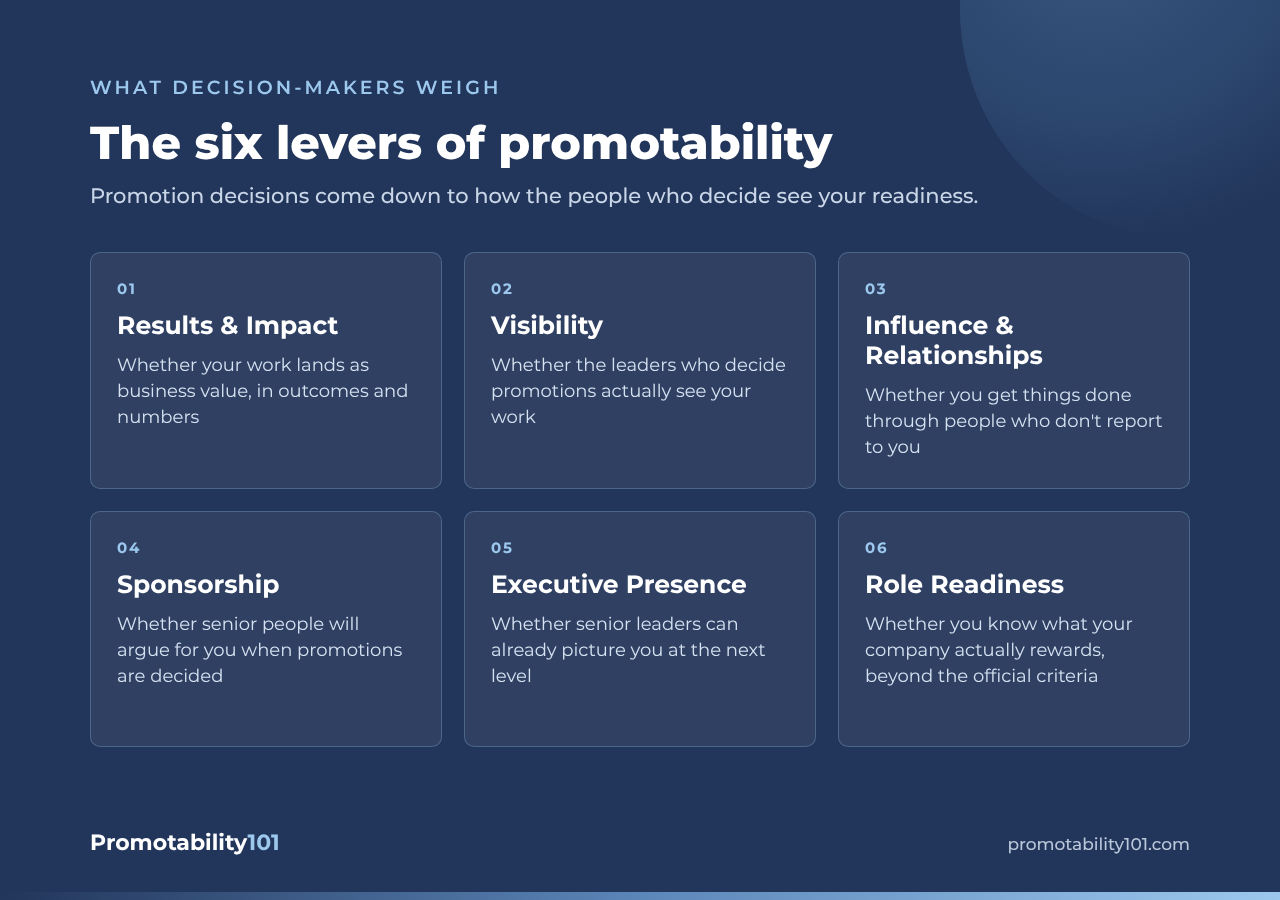
Promotion decisions are rarely about who works hardest. They come down to how the people who decide see your readiness, across six levers.
| Lever | What decision-makers are judging |
|---|---|
| Results & Impact | Whether your work lands as business value, in outcomes and numbers |
| Visibility | Whether the leaders who decide promotions actually see your work |
| Influence & Relationships | Whether you get things done through people who don't report to you |
| Sponsorship | Whether senior people will argue for you when promotions are decided |
| Executive Presence | Whether senior leaders can already picture you at the next level |
| Role Readiness | Whether you know what your company actually rewards, beyond the official criteria |
The levers that sound soft carry real weight. Senior executives told the Center for Talent Innovation that executive presence accounts for 26% of what it takes to get the next promotion (2012 study of 268 senior executives).
Not sure which lever is holding you back? The free Promotability Score shows you in about 3 minutes. Get your Promotability Score →
Why a written plan matters
- Written goals get done more often. In Dr. Gail Matthews' goal study at Dominican University, people who wrote their goals, committed to actions and sent weekly progress reports accomplished significantly more than people who only thought about their goals.
- It gives your manager something to work with. In a Korn Ferry survey of 1,327 professionals, 77% said their first move toward a promotion would be a conversation with their boss about growth areas. A plan makes that conversation specific. More on that in the quarterly career conversation most people never have.
- It points your effort at what counts. Not one respondent in that Korn Ferry survey picked working longer hours as their path to promotion. A plan aims your effort at what decision-makers weigh.
Signs you need a promotion plan
- You've been told "you're not ready" with no explanation of what ready looks like.
- You're stuck at the same level while peers move up.
- You can't name who decides your next promotion.
- Your manager couldn't say what role you want next.
- Your best results are known mostly to your own team.
Promotion plan vs. development plan vs. PIP
A promotion plan is the only one of the three aimed at a specific next role. The timelines below are typical ranges and vary by company.
| Promotion plan | Individual development plan (IDP) | Performance improvement plan (PIP) | |
|---|---|---|---|
| Goal | Get a specific role by a date | Build skills over time | Fix performance in your current role |
| Who starts it | You | You and your manager | Your manager or HR |
| Focus | How decision-makers see your readiness | Skills and training | Gaps against current expectations |
| Typical length | 12 to 24 months | 6 to 12 months | 30 to 90 days |
| Measured by | The promotion decision | Skills gained | Meeting set targets |
What is Promotability 101?
Promotability 101 is an online course that teaches managers and directors how promotion decisions actually get made and how to build the six levers decision-makers weigh. The course ends with you building your Personal Promotability Plan.
- 6 modules and 30 video sessions
- The 20-tool Promotability Toolkit, including the Personal Promotability Plan template
- Self-paced, about 4 to 6 weeks at 1 to 2 hours a week, with lifetime access
- $297 introductory price and a 30-day money-back guarantee
It was created by Michelle Smith, President of Berg Communications Global. She spent about 15 years at Jabil, a $30 billion global manufacturer with 260,000 employees, and was promoted three times there, from Senior Manager to Vice President of Communications & Brand Strategy.
Why Promotability 101 exists
Most people are never told how promotion decisions get made. In one survey, 13% of employees had no idea how advancement was decided and 44% believed it came down to who you know. Promotability 101 replaces that guesswork with a clear picture of what decision-makers weigh and a plan built around it.
What to do next
- Take the free Promotability Score to find your weakest lever. It takes about 3 minutes.
- Read how to ask for a promotion without it sounding like a favor.
- When you're ready to build your plan, join Promotability 101 for $297, with a 30-day money-back guarantee.
FAQ
What is a promotion plan?
A promotion plan is a written plan for getting promoted to a specific role by a specific date. It names the gap between how decision-makers see you now and how they need to see you.
What's the difference between a promotion plan and an IDP?
An individual development plan builds skills over time. A promotion plan builds the case that you're ready for a specific role, including visibility and sponsorship, which skills training alone doesn't cover.
Do I need a promotion plan if my manager supports me?
Yes. Your manager is usually one of several people who decide on a promotion. A promotion plan accounts for how all of them see you, not just your manager.
What is Promotability 101?
Promotability 101 is a $297 self-paced online course by Michelle Smith that teaches managers and directors how promotion decisions get made. The course ends with each student building a Personal Promotability Plan.
Is there a free way to start?
Yes. The free Promotability Score is a 16-question assessment that takes about 3 minutes and names your weakest of the six levers.
A plan starts with knowing where you stand. Get your Promotability Score →
Sources
- Korn Ferry, "Raise or Recognition?" survey release, January 14, 2019. 1,327 professionals, December 2018.
- Canadian HR Reporter, "4 in 10 workers think it's 'who you know' that determines promotions", June 26, 2012. Right Management survey of 500 U.S. and Canadian employees.
- FM Magazine, "Upskilling doesn't always lead to internal progression", April 2, 2025. McLean & Company Employee Engagement Trends Report 2025.
- Center for Talent Innovation (now Coqual), Executive Presence key findings, 2012. 268 senior executives.
- Dominican University, Gail Matthews, Goals Research Summary.